


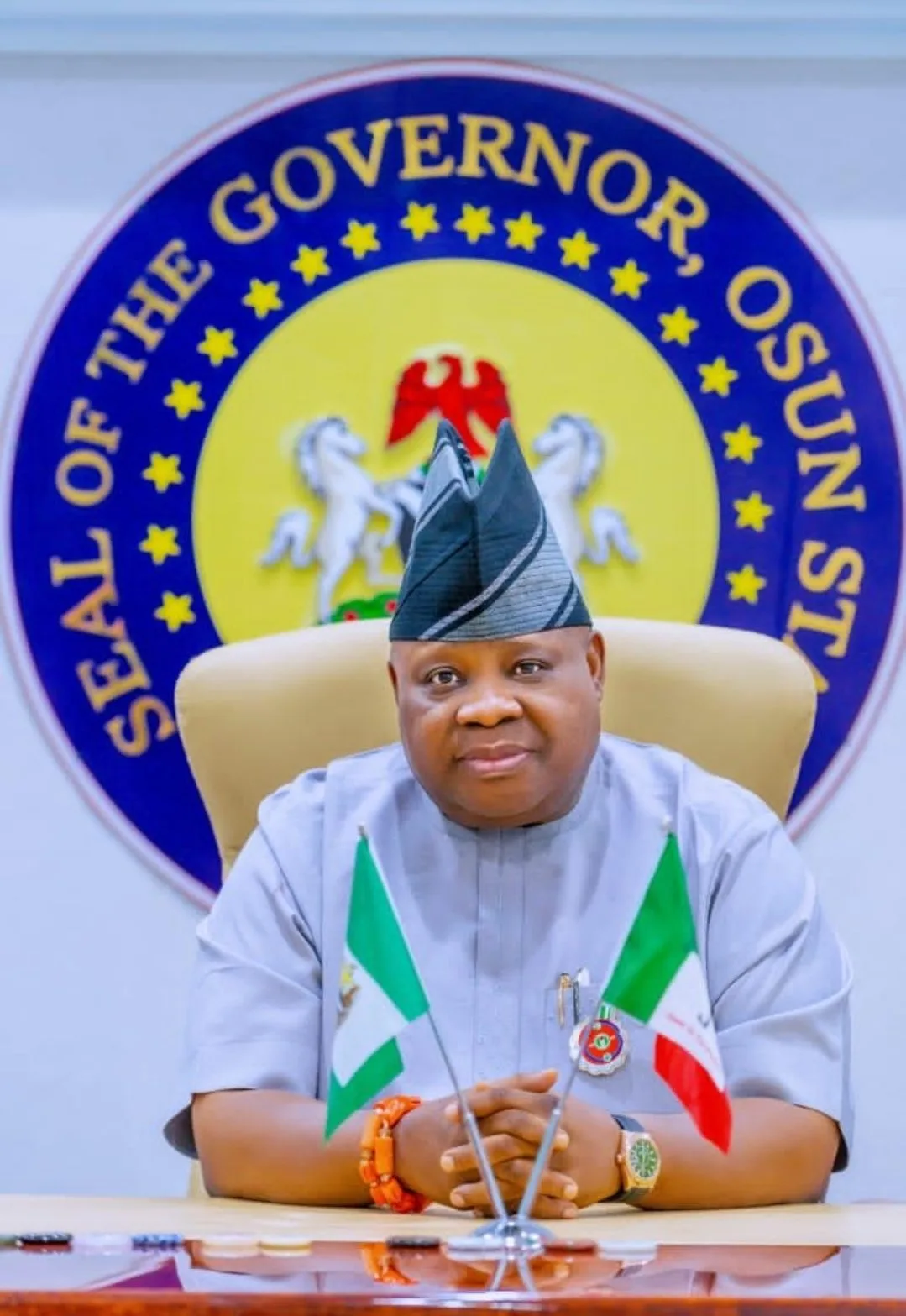
The Osun State Government has approached the Federal High Court to challenge the Economic and Financial Crimes Commission (EFCC) over the freezing of one of its bank accounts, a move that has opened a new chapter in the ongoing investigation into the state’s payroll and financial records.
The state government is seeking judicial intervention, arguing that the EFCC’s decision to freeze its account could disrupt government operations, delay salary payments, and affect the delivery of essential public services. It urged the court to declare the action unlawful and order the immediate unfreezing of the account.
The development comes months after Governor Ademola Adeleke’s administration formally invited the EFCC to investigate allegations of ghost workers and a padded payroll inherited by the current government.
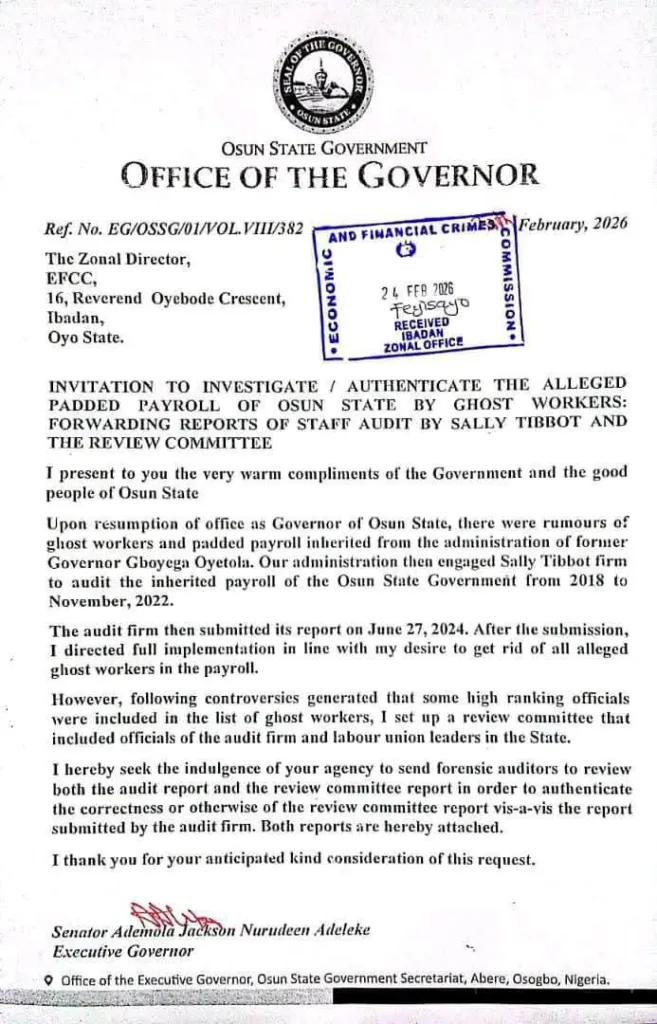
In a letter dated February 2026 and addressed to the EFCC Zonal Director in Ibadan, Governor Adeleke requested the anti-graft agency to conduct a forensic investigation into the alleged payroll fraud. The letter, titled “Invitation to Investigate/Authenticate the Alleged Padded Payroll of Osun State by Ghost Workers,” explained that upon assumption of office, the administration inherited widespread allegations of ghost workers and payroll irregularities from the previous administration.
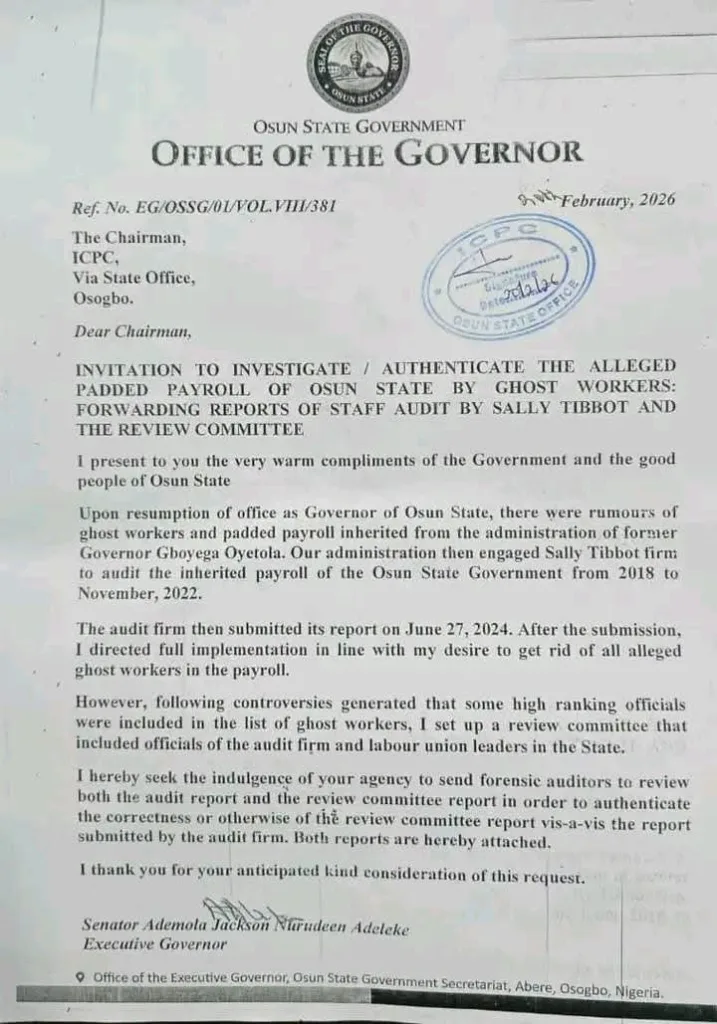
According to the governor, his administration engaged an independent audit firm, Sally Tibbot, to carry out a comprehensive audit of the state’s payroll covering the period from 2018 to November 2022. The audit report was submitted on June 27, 2024, after which the government began implementing its recommendations to eliminate alleged ghost workers from the payroll.
However, following controversies surrounding the audit report—including claims that some senior government officials were listed among the alleged ghost workers—the governor constituted a review committee comprising representatives of labour unions and officials of the audit firm to reassess the findings.
In the letter, Governor Adeleke requested the EFCC to deploy forensic auditors to authenticate both the original audit report and the review committee’s findings in order to determine the accurate position and ensure credibility in the investigation.
The EFCC subsequently commenced its investigation into the payroll allegations and related financial transactions. However, the commission’s recent decision to freeze one of the state’s bank accounts has now resulted in a legal battle between both parties.
The Osun State Government maintains that while it willingly invited the EFCC to investigate the alleged payroll fraud in the interest of transparency and accountability, freezing the state’s account goes beyond the scope of the investigation and threatens the smooth running of government.
The outcome of the suit is expected to determine the extent of the EFCC’s powers in ongoing investigations involving state governments, while also shaping the next phase of the probe into the alleged ghost worker scandal that has remained a major political issue in Osun State ahead of the forthcoming governorship election.