

The presidential candidate of the Accord Party, Gbenga Olawepo-Hashim, has said Nigerians will not pay more than ₦605 per litre for petrol under an Accord administration, arguing that the price could eventually fall to as low as ₦200 per litre if the country addresses production costs and exchange rate challenges.
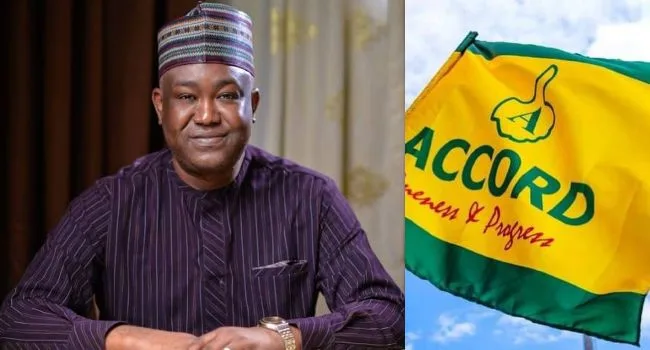
Hashim said the proposed ₦605 per litre price would be a sustainable starting price rather than an artificially subsidised rate.
He maintained that Nigerians would not pay above ₦610 per litre under his proposed administration, while expressing confidence that the price could eventually drop significantly if Nigeria improves its domestic petroleum production and stabilises the naira.
“₦605 per litre is our starting sustainable price for petrol. Nobody will buy petrol above ₦610 under our government. It could be as low as ₦200,” he said.
The Accord presidential candidate argued that achieving a lower petrol price would not require a return to an opaque subsidy regime or result in a reduction in government revenue and Federation Account Allocation Committee revenues.
According to him, the major challenge lies in Nigeria’s petroleum cost structure and the way the country calculates the cost of supplying refined products to the domestic market.
Hashim, who has consistently criticised the removal of petrol subsidy, said subsidy should not automatically be regarded as illegitimate where government intervention is transparent, targeted and designed to achieve clearly defined economic objectives.
He described some of the arguments previously used to justify subsidy removal as “accounting magic,” insisting that Nigeria must first determine the genuine cost of producing, refining, transporting and distributing petrol before concluding that the government is subsidising consumers.
“Any time you sell a product above its legitimate cost of production, refining, transportation and insurance, you cannot call the difference between that price and an international benchmark a subsidy loss. That is opportunity cost,” he said.
Hashim argued that Nigeria has often relied on international market benchmarks when determining the domestic value of crude oil and refined petroleum products instead of establishing the actual cost incurred in producing and delivering petrol to Nigerian consumers.
He said such an approach could create the impression that government is automatically incurring losses whenever petroleum products are sold below international benchmark prices.
“A country does not subsidise itself simply because it chooses to use its own resources to provide affordable energy to its citizens,” he added.
The Accord candidate called for an independent forensic audit of Nigeria’s entire petroleum cost structure.
He said the audit should cover crude oil production, contracting, procurement, refining, transportation, storage, insurance, pipeline operations and distribution.
According to him, the exercise should establish the actual cost of producing and delivering every litre of petrol consumed in Nigeria.
“Show Nigerians the books. Publish the production cost. Publish refinery cost. Publish transportation. Publish insurance. Publish every margin. Let the data speak,” Hashim said.
He argued that the country’s high petroleum costs should not simply be transferred to consumers without first investigating the factors responsible for the expenses.
The presidential candidate questioned why Nigeria’s petroleum production costs remain relatively high compared with those of other major oil-producing countries.
He identified contracting, procurement, insecurity, operational inefficiencies and possible cost inflation as areas requiring closer examination.
“Before asking Nigerians to pay more, government must first explain why it costs so much to produce our own oil. If the cost is genuine, show us the evidence. If it is inefficiency, corruption or inflated contracting, fix it,” he said.
‘Nigerians Should Not Pay Twice’
Hashim maintained that Nigerians are effectively bearing the consequences of inefficiencies within the petroleum sector twice — first through potentially high production and operational costs and subsequently through higher pump prices.
He argued that the government should address inefficiencies within the sector rather than simply transferring the resulting costs to consumers.
“The Nigerian people should not pay for inefficiency twice. They should not pay for inflated costs inside the system and then be told that the resulting high price is the inevitable consequence of subsidy removal,” he said.
Hashim’s proposal places affordable petrol prices at the centre of his economic argument ahead of the 2027 presidential election, with the Accord candidate insisting that Nigeria can achieve lower energy costs by improving domestic production, reducing waste and inefficiency, and establishing greater transparency in the petroleum sector.